The other day my kids asked me that if I had the choice to become one of the "Avengers", which one would I be ?
My Answer, " Captain America" didn't really go well with my youngest one.
"All the Superheroes with all those Superpowers and you chose that one?"
My logic was simple.
I truly believe that of all the Superpowers in the world, Righteousness is the most difficult to attain and maintain.
Thor, Iron man, Hulk and the others may have their own (fatal) attractions ( especially Thor ;-) but they all belong to a world of fantasy and their powers are mostly mythical and unrealistic. Entertaining, but unrealistic.
Captain America is one who truly exits in our world or can exist in our world, should we strive for it.
So the fantasy world is welcome to have its range of fantastic Avengers with all their fantastic Superpowers, but in the real world I prefer to have Captain Americas, as many as possible.
For even the presence of one righteous person can counter the venomous effects of a hundred unrighteous.
Saturday, March 30, 2019

Sunday, March 17, 2019
Jerash
The ancient city of Jerash is located in the North of Jordan's capital Amman.
Throughout different periods of history, Jerash has been occupied by the Greeks, Persian, Romans, Byzantine Christians and finally Muslims, but the most significantly visible influence on the city is that of the Roman occupation. And that is evident from the moment you enter the city through Hadrian's gate which was especially constructed for the Roman Emperor Hadrian's visit to this city sometime in the second century AD.
 After passing through the gate, the first structure one comes across is the massive Hippodrome. All Roman cities had hippodromes for chariot races and other kinds of sports. Chariot racing was an essential part of Roman life and they took this sport with them pretty much everywhere they went and Jerash is no exception.
Like all Roman cities, Jerash was also constructed according to Roman standards and has several common features with other Roman cities. Some of these features were:
Central Plaza
The oval plaza with a sacrificial alter in the centre. It was probably the Greeks who initially built the original plaza but it was much smaller than the current one. When the Romans came they moved the circle outwards and added more columns. Why? because Romans liked things bigger and better.
Colonnaded street
The colonnaded street is called the Cardo Maximus. The Romans were not just conquerors, they were also master builders of the ancient world. From roads to aqueducts, from bridges to baths, from arenas to temples, everything was built to perfection. The drains of Jerash run under the Cardo Maximus. So if you pour water over the road it goes down discreet little holes and disappears, leaving the area dry. It is a shame that many of our roads in this time and age turn into canals if it happens to rain a bit too heavily. Our road builders need to learn some things from these ancient Romans.
The Souq
The old market area had a central fountain and shops were build around this area in circular fashion. Shops ranged from those of cloth merchants, butchers and others selling items of daily requirement.
 Last but not least the "Temples". Romans were nothing if not religious.
Although Zeus is the principal deity but the main goddess of Jerash was Artemis. Women from all over came to the temple of Artemis to pray. Why? because in addition to being the goddess of hunting and wildlife Artemis is also the goddess of fertility and childbirth.
The stairs that lead to the Temple of Artemis are the original 1800 year old ones and appear to be leading towards the heaven. They were purposely built that way to impress upon people the heavenly status of Artemis. They are built in sets of seven. After every seven steps there is a bit of flat area and then another set of seven steps and so on. There a a total of seven sets of seven steps each, leading to the temple. Since the temple is built not directly at the top but a little way way back , it does not come into view until you have reached at least the fifth set of steps.
 Roman cities are usually built to impress and this one fits the bill perfectly. Even in its semi ruined state its grandeur, architecture and design leaves one in awe. Mind you, the city was for Romans who were occupying this land. All non Romans, including the local population lived outside the walls of the city in their humble abodes. Bet that didn't go well with the local populace but as the Romans were the conquerors / rulers , there was little that the locals could do about it.
The entrance ticket to Jerash costs about 10 JOD and a guided tour in English another 30 JOD. If one is familiar with the layout of ancient Roman cities, one can skip the guided tour. Free Visitor's guides are also available in the museum located just out side the entrance of the ancient city. Those and a bit of pre-visit internet research should be enough to set one up for a day's casual visit to the ancient city of Jerash.
Throughout different periods of history, Jerash has been occupied by the Greeks, Persian, Romans, Byzantine Christians and finally Muslims, but the most significantly visible influence on the city is that of the Roman occupation. And that is evident from the moment you enter the city through Hadrian's gate which was especially constructed for the Roman Emperor Hadrian's visit to this city sometime in the second century AD.

Like all Roman cities, Jerash was also constructed according to Roman standards and has several common features with other Roman cities. Some of these features were:
Central Plaza
The oval plaza with a sacrificial alter in the centre. It was probably the Greeks who initially built the original plaza but it was much smaller than the current one. When the Romans came they moved the circle outwards and added more columns. Why? because Romans liked things bigger and better.
Colonnaded street
The colonnaded street is called the Cardo Maximus. The Romans were not just conquerors, they were also master builders of the ancient world. From roads to aqueducts, from bridges to baths, from arenas to temples, everything was built to perfection. The drains of Jerash run under the Cardo Maximus. So if you pour water over the road it goes down discreet little holes and disappears, leaving the area dry. It is a shame that many of our roads in this time and age turn into canals if it happens to rain a bit too heavily. Our road builders need to learn some things from these ancient Romans.
The Souq
The old market area had a central fountain and shops were build around this area in circular fashion. Shops ranged from those of cloth merchants, butchers and others selling items of daily requirement.
 Last but not least the "Temples". Romans were nothing if not religious.
Although Zeus is the principal deity but the main goddess of Jerash was Artemis. Women from all over came to the temple of Artemis to pray. Why? because in addition to being the goddess of hunting and wildlife Artemis is also the goddess of fertility and childbirth.
The stairs that lead to the Temple of Artemis are the original 1800 year old ones and appear to be leading towards the heaven. They were purposely built that way to impress upon people the heavenly status of Artemis. They are built in sets of seven. After every seven steps there is a bit of flat area and then another set of seven steps and so on. There a a total of seven sets of seven steps each, leading to the temple. Since the temple is built not directly at the top but a little way way back , it does not come into view until you have reached at least the fifth set of steps.
 Roman cities are usually built to impress and this one fits the bill perfectly. Even in its semi ruined state its grandeur, architecture and design leaves one in awe. Mind you, the city was for Romans who were occupying this land. All non Romans, including the local population lived outside the walls of the city in their humble abodes. Bet that didn't go well with the local populace but as the Romans were the conquerors / rulers , there was little that the locals could do about it.
The entrance ticket to Jerash costs about 10 JOD and a guided tour in English another 30 JOD. If one is familiar with the layout of ancient Roman cities, one can skip the guided tour. Free Visitor's guides are also available in the museum located just out side the entrance of the ancient city. Those and a bit of pre-visit internet research should be enough to set one up for a day's casual visit to the ancient city of Jerash.
Saturday, February 16, 2019
Wadi Rum

Wadi Rum means
"valley of the moon". It is a vast expanse of desert in the southern
part of Jordan that has red coloured sand and some unique rock structures.
It is located in
Aqaba District and is about an hour's drive from Petra. So if one is
planning a trip to Petra, it is not a bad idea to include a visit to Wadi Rum as
well. Tour of the desert is quite cheap compared to Petra. Another option
is to reach Aqaba from Amman and then take a taxi to Wadi Rum which is about
half an hour’s drive from there. All three locations are situated in the south
of Amman in the following order: Petra and then Wadi Rum and Aqaba.
Wadi Rum is a desert,
with no roads, buildings or any other kind of basic infrastructure facility, so no bus
or any other kind of mass transit system reaches it. One has to take a taxi
from either Aqaba or Petra to get to it. Taxi from Petra to Wadi Rums costs
around 40 JODs and can seat 4 passengers. Taxi from Aqaba costs around 25 JODs. Foreigners and non-Jordanians are
also required to pay a 5 JOD per person entrance fee before entering the Wadi Rum Protected area which is a UNESCO World Heritage Site.
As far as I can recall
it is not possible to visit the desert on your own (though I may be wrong about this). One has to book a tour with
one of the local tour company/ camping site to be able to access it.
 |
| Queen of the Bedouins |
But why go at all?
Because it is one of the
most amazingly mesmerising places on earth.
Due to its unique red
coloured sand, Wadi Rum has been depicted as the surface of the planet Mars in
the movie, " The Martian". Apart from "The Martian", the
natural settings of Wadi Rum have served as the set of several other films
including shooting of scenes from, Transformers: Revenge of the Fallen,
Prometheus, Rogue One: a star Wars story and lately Aladdin, to name a few.
Perhaps the movie that
made Wadi Rum famous was David Lean's 1962 film, "Lawrence of
Arabia". There is a particular area called Lawrence's Spring here which got its name because
the lead character, Peter O Tool, who played the part of "Lawrence of Arabia", used to come to this place with
his crew members to collect water. The spring is located up on a hill.
It is a 20 or so minutes climb to the spring but since water is scarce in the
desert, the climb is worth it.
Ancient inscriptions on
the rocks near the spring told ancient travellers about the presence and location
of water. I guess it was a kind of primordial sign board.
The local Bedouins use
water sparingly, it being a precious commodity. Apart from the natural
springs, another source of water is the rain water reserves which fill up
during the rains and can be used by the locals for several months afterwards.
There are many beautiful
rock formations in the desert and several canyons, arches and sand dunes that
can be climbed. The climb is neither easy nor for the faint hearted but the view at the top makes the whole effort worthwhile. Not to mention that the climb itself gives one a sense of achievement.
 A four hour or more tour of Wadi
Rum is gruelling and strongly tests your stamina and endurance. It can be demanding but exhilarating. Local Bedouins act as guides. Fortunately,
you are allowed to rest in the middle and offered free Bedouin hospitality tea,
as much as you want to drink, to freshen you up. It is always a good idea to
make sure that the guide being allocated to you speaks reasonable enough English.
His being talkative and gregarious can be a bonus because then he is
likely to offer more information about the desert as compared to a silent,
brooding one. There is one Bedouin village inside the Wadi Rum Protected area and many Bedouin families have now taken up residence there but from time to time many go back to the desert and live there for months following their centuries old way of life surviving only on what nature provides them with. They are nomads at heart and setting up roots in one place does not appeal to them.
A four hour or more tour of Wadi
Rum is gruelling and strongly tests your stamina and endurance. It can be demanding but exhilarating. Local Bedouins act as guides. Fortunately,
you are allowed to rest in the middle and offered free Bedouin hospitality tea,
as much as you want to drink, to freshen you up. It is always a good idea to
make sure that the guide being allocated to you speaks reasonable enough English.
His being talkative and gregarious can be a bonus because then he is
likely to offer more information about the desert as compared to a silent,
brooding one. There is one Bedouin village inside the Wadi Rum Protected area and many Bedouin families have now taken up residence there but from time to time many go back to the desert and live there for months following their centuries old way of life surviving only on what nature provides them with. They are nomads at heart and setting up roots in one place does not appeal to them.
Wadi Rum is known for
its magnificent view of a star filled sky especially on moonless nights but I
think it is the vast expanse of open space that that makes the desert truly
amazing . The openness of the vast rust coloured stretch of land gives one a
sense of freedom and liberty. Stretching for miles in all directions, the desert
appears limitless as if existing in a timeless capsule of its own, away from
the mad hustle and bustle of the modern world.
Definitely a place worth
adding to one’s bucket list.
Saturday, February 9, 2019
Petra: Land of the Nabateans
The city of Petra is located in Wadi Musa at about 4 hours’ drive from Amman in the southern direction and the best and the most economical way to get to it is through JETT bus service. One-way ticket to Petra costs around 11 JOD (Jordanian Dinar) and a return one costs 18 (though the price may have gone up in the last six months since I was there but I doubt it, and even if it did, it could not have increased more than one or two dinars).
The daily Jett bus to Petra leaves fairly early in the morning. It has three stops within the city of Amman. First stop: Abdali at 6:30 am, Second Stop: in front of Intercontinental Hotel at the second Circle at 6:45 am, then last and final stop is at the Jett bus station itself near the 7th Circle at 7:00 am. From 7th Circle the bus leaves for Petra sometime between 7:15 - 7:30 am. If one misses catching the bus at either of the two earlier stops, one can always take a cab to the next station and hop on (provided one has a ticket) but once the bus leaves from the 7th circle, it is gone for good and does not stop, except for a midway break between Amman and Petra. The Jett bus station at Petra is right next to the entrance of Petra visitors' center which is the gate to the ancient historic site. Arrival time here is sometime after 11:00 am. For those who plan a day trip, the same bus returns to Amman at 5:00 pm (summer time) on the same day but one has to be at the station by 4:45 pm at least (preferably 4:30 pm). Reason being that a lot of non-ticket holders also hover around the station near departure time and if the regular ticket holders are missing, the seats are sold to the ones in the waiting line. The age old saying that time and tide wait for no one can be modified a little to say that the Jett bus also waits for no one. It departs at 5:00 pm sharp even if there is no waiting line and it has to go back with empty seats.
A five-hour duration between 11:30 in the morning till 4:30 in the afternoon can be enough time for the excursion of the ancient city of Petra but only if the main trail is followed. A more detailed exploration requires more time. I personally think that a master piece of ancient civilization like Petra deserves more than a hurried tour.
An overnight stay at one of the local hotels gives an extra day plus the opportunity to start early the next day. Also the entry ticket to Petra is quite on the expensive side, about 50 JOD per person per day but an extra 5 JOD gets one a two-day access to the site. (It is possible to buy a Jett bus return ticket which takes one back to Amman on the next day instead of the same one but that has to specified at the time of purchase as the travelling dates are mentioned on the tickets).
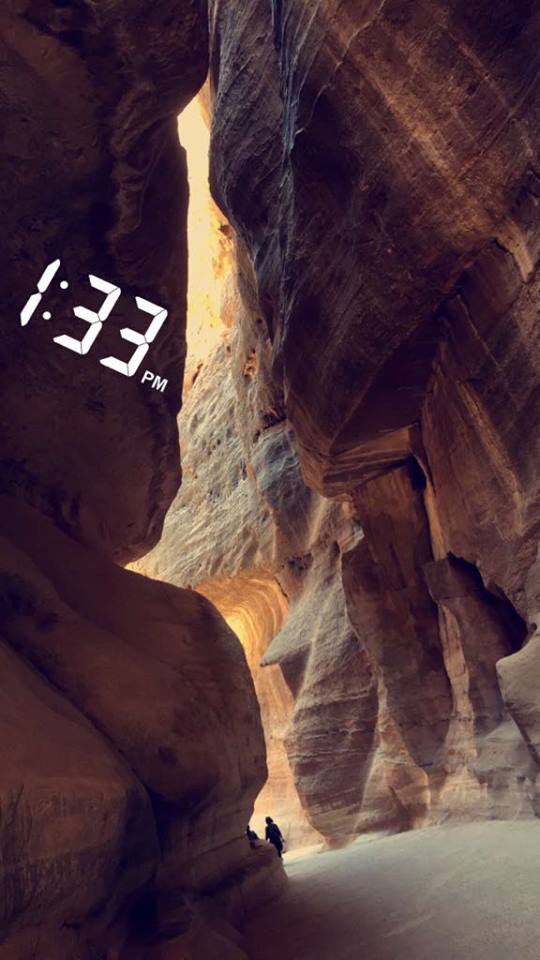 |
| The "Siq" |
Nick named the Rose city because of the rose coloured stones, Petra was most probably the capital city of the Nabatean Kingdom, a nation of trading Arabs who constructed buildings by digging into and carving the surrounding stone structures.
 |
| Al Khazneh: The Treasury |
The treasury or “Al Khazneh” is one of the most celebrated structures at Petra. It is one of the wonders of the modern world and has been portrayed in several films including "Indiana Jones and the last Crusade". The area in front of the Treasury is almost never empty. Since it is one of the most photographed sites in the world, there is always a horde of tourist clicking away at its impressive stone façade.
For those who are not much into walking, several different modes of transportation are also available. Horse drawn carriages that take one from the main gate till the Treasury and back, camels along the main path and sturdy mules that can take one up all the way to the Monastery. Like in all other places in Jordan (other than branded shops in malls) bargaining is a must, and nothing short of one third of the price quoted should be settled upon. And no matter what ever amount is settled upon, be prepared for a “tip” request in the end as well.
 From the Treasury, the main path takes one through a multitude of ancient historic
structures that include the Ancient Nabatean theatre, Royal Tombs and the Roman
era ruins among others. There are many side trails leading to less popular sites but unless one is
of an adventurous nature and has ample
From the Treasury, the main path takes one through a multitude of ancient historic
structures that include the Ancient Nabatean theatre, Royal Tombs and the Roman
era ruins among others. There are many side trails leading to less popular sites but unless one is
of an adventurous nature and has ampletime, like more than one day, only then these should be explored.
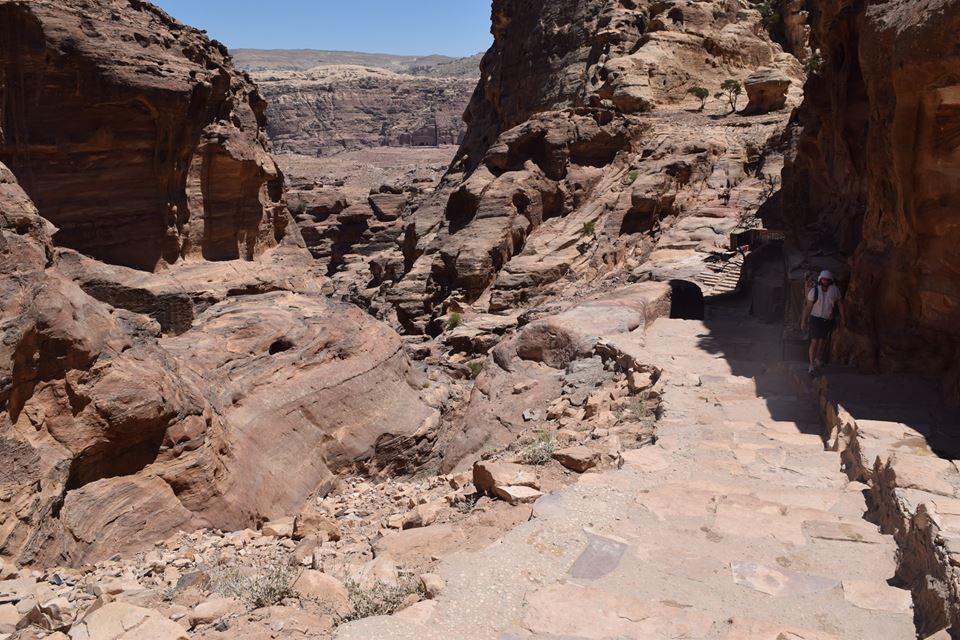
The ascent to the “Monastery” starts where the main trail comes to an end. One can either choose to return form this point or climb the stairs all the way up to the Monastery. The stairs are actually steps cut into stone and t
here are a 960 of them in total. ( I used to think that the 300 something steps to Batu Caves in Malaysia were tough but they are nothing compared to the ones leading to the Monastery at Petra). It takes at least 45 minutes to an hour for a hale and hearty person to go up those steps. For the not so hale and hearty, the option to go atop a mule is available for a price of 10-12 Dinars. At regular intervals throughout the climb, local Bedouins have their makeshift stalls set up that sell trinkets, souvenirs and even cool water to the tourists.
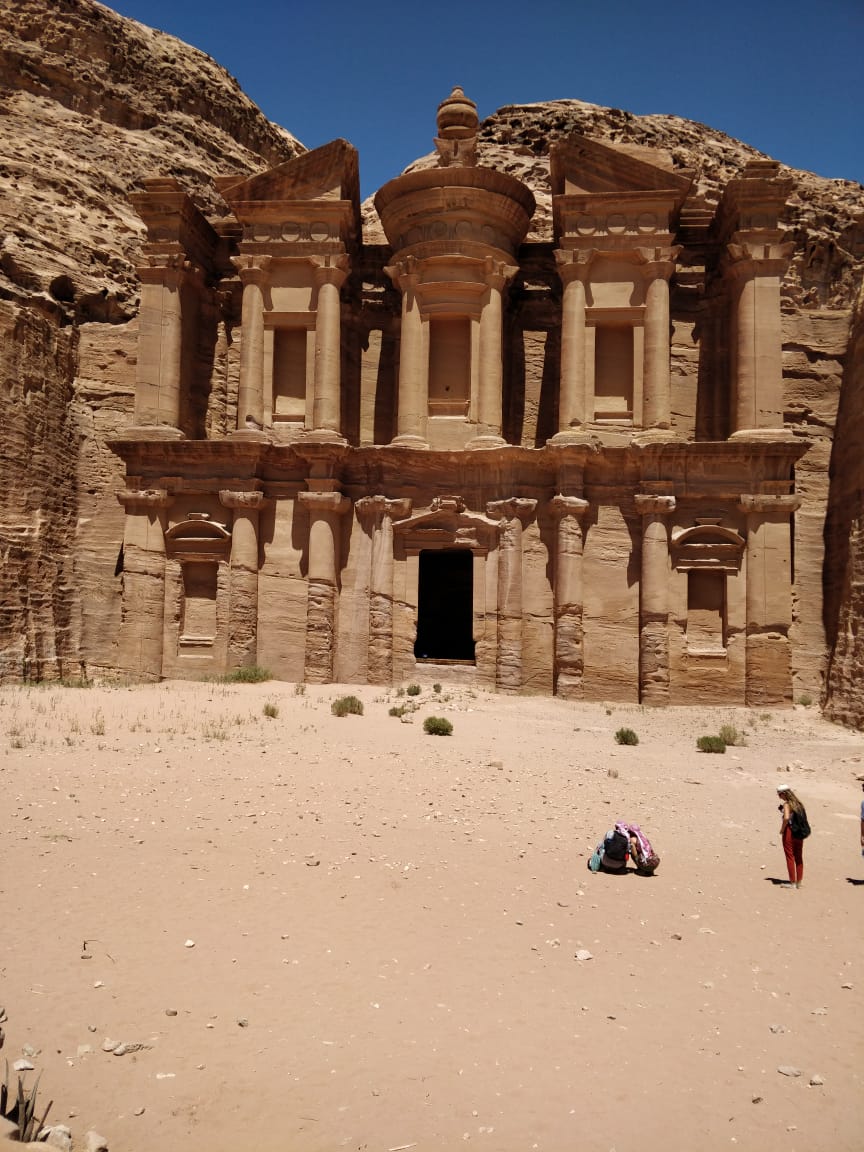 |
| Al Dier: The Monastery |
To be honest, I think I am already half way there.
|
|
Tuesday, February 5, 2019
Ajlun: The Castle that was never conquered
For some reason the Middle Eastern
region has always been a tumultuous one, be it contemporary times or the Middle
Ages. Located at the cross roads of the known world back in ancient times, the
Middle Eastern region was not only richer in history and culture as compared to
any other part of the world, it also had the best produce and most favorable
weather. If this was not enough reason for nations to fight to gain control
over it, then the fact that it also happened to be the birth place of the major
religions of the world, made it the most sought after piece of land.

Most of the Medieval castles that I have seen are in ruins, little more than piles of stones and half broken walls but Ajlun is pretty intact. While walking through its numerous corridors, rooms and going up and down the stairways, it is not difficult to imagine what the castle must have looked like at its peak, complete with furniture and occupants.
Not at all difficult to visualize where in the center of the room a huge long table may have been placed to serve food. (that is, if the Muslim soldiers used a table to eat back then. It may be possible that using a table for meals was a European custom that might have arrived with the crusaders). Nor is it difficult to envision where the sleeping quarters would have been for the regular guards of the castle and possibly of those soldiers who were passing through the area to go resume their duties in more disturbed regions.
 Each chamber, each corridor reveals
new images of years gone by and tells new stories of what must have once been. There
is enough loose yarn of historic ambiance spread throughout the facility to
weave into an imaginary pattern of events and actions that might have taken
place there centuries ago. All that is needed is a little over active
imagination and a desire to lose oneself in the mysteries that the castle is so
willing to reveal.
Each chamber, each corridor reveals
new images of years gone by and tells new stories of what must have once been. There
is enough loose yarn of historic ambiance spread throughout the facility to
weave into an imaginary pattern of events and actions that might have taken
place there centuries ago. All that is needed is a little over active
imagination and a desire to lose oneself in the mysteries that the castle is so
willing to reveal.
Back in the days when this land was not divided through borders into multiple nations, the whole area formed one huge region under the Muslim’s rule. The roof of the Castle not only offers an unlimited view for miles and beyond in all directions to what in current day is Lebanon, Syria and Israel, it also provides the coolest breeze ever, even in the middle of the hot summer season. The orchards in the valley below produce the most wondrous variety of olives, figs and grapes. There is also a special tower where pigeons used to be kept. These served as speedy means of communication in times of war as well as in peace time
It was no doubt ideally located given the circumstances of that time and it obviously boasted excellent defensive mechanism as well but I personally believe that being located on high ground as compared to the surrounding area also made it extremely difficult, if not totally impossible to be captured by an invading army. Perhaps that is why unlike most castles and keeps in the area that have come under the rule of the invading crusaders at some point or the other, Ajlun was never subjugated and to this day remains the Castle that was never conquered.
For hundreds of years the Church and
the Monarchies of Europe joined hands together to send wave after wave of
Christian Zealot fighters to free the Holy lands from the clutches of what they
called the “infidels” ; or in other words "The Muslims".

But the Muslims of the area did not take this lying down.
Perched on top of a hill,
above the valley of Jordan, overlooking the wide horizons,
sits the Castle at Ajlun.
Built on the orders of Salahudin, sometime
during the 12th century, probably on the site of an old Byzantine monastery,
the purpose of construction of the castle at Ajlun was to protect the
area from foreign invaders i.e the crusaders. Most of the Medieval castles that I have seen are in ruins, little more than piles of stones and half broken walls but Ajlun is pretty intact. While walking through its numerous corridors, rooms and going up and down the stairways, it is not difficult to imagine what the castle must have looked like at its peak, complete with furniture and occupants.
Not at all difficult to visualize where in the center of the room a huge long table may have been placed to serve food. (that is, if the Muslim soldiers used a table to eat back then. It may be possible that using a table for meals was a European custom that might have arrived with the crusaders). Nor is it difficult to envision where the sleeping quarters would have been for the regular guards of the castle and possibly of those soldiers who were passing through the area to go resume their duties in more disturbed regions.
 Each chamber, each corridor reveals
new images of years gone by and tells new stories of what must have once been. There
is enough loose yarn of historic ambiance spread throughout the facility to
weave into an imaginary pattern of events and actions that might have taken
place there centuries ago. All that is needed is a little over active
imagination and a desire to lose oneself in the mysteries that the castle is so
willing to reveal.
Each chamber, each corridor reveals
new images of years gone by and tells new stories of what must have once been. There
is enough loose yarn of historic ambiance spread throughout the facility to
weave into an imaginary pattern of events and actions that might have taken
place there centuries ago. All that is needed is a little over active
imagination and a desire to lose oneself in the mysteries that the castle is so
willing to reveal. Back in the days when this land was not divided through borders into multiple nations, the whole area formed one huge region under the Muslim’s rule. The roof of the Castle not only offers an unlimited view for miles and beyond in all directions to what in current day is Lebanon, Syria and Israel, it also provides the coolest breeze ever, even in the middle of the hot summer season. The orchards in the valley below produce the most wondrous variety of olives, figs and grapes. There is also a special tower where pigeons used to be kept. These served as speedy means of communication in times of war as well as in peace time
It was no doubt ideally located given the circumstances of that time and it obviously boasted excellent defensive mechanism as well but I personally believe that being located on high ground as compared to the surrounding area also made it extremely difficult, if not totally impossible to be captured by an invading army. Perhaps that is why unlike most castles and keeps in the area that have come under the rule of the invading crusaders at some point or the other, Ajlun was never subjugated and to this day remains the Castle that was never conquered.
Saturday, March 24, 2018
Lawn Mania
Everywhere I go these days I see huge billboards advertising
one brand of lawn or the other.
The photo shoots for these advertisements take place at exotic locations all over the world which goes to show the huge amount of budget allocated for marketing of these brands.
Not only are these brands exorbitantly
overpriced, but way too many in my opinion and yet I still hear women
complaining that they could not get the print of their choice because it was
sold out.
What is it about a few meters of cloth that makes decent women behave like complete hooligans?
It is almost as if the entire female population of our
country is collectively suffering from “Lawn Mania”.
Although our Pakistani ladies' obsession with designer lawns may not be in the same league as the Dutch's fascination with Tulips, nor the price that high (yet) but in essence it is the same: paying for something that is clearly not worth the outrageous amount being paid for it.
Wednesday, January 3, 2018
Frustrated
Why is it that people in our country think that it is OK to cut lines ,OK to jump red lights ,OK to block exits , OK to throw garbage straight out of their car windows and so on. There is an entire list of "don'ts" that people do, not just with out giving it a second thought but also with out any kind of awareness that they are doing anything wrong.
I used to think that people do that because the repercussions are not there. Why else would the same people who drive around with cars that exhale smoke heavier than chimneys or broken side view mirrors would become so law abiding and so conscious of not committing traffic violations as soon as they go abroad. That is because they know they will not be able to get away with any of the violations they commit on or off the roads . They know that abroad there is no getting away by offering somebody the a little green note to turn a blind eye to their crime or calling up some superior relation occupying a position of authority on the the phone and asking them to intervene.I also used to think this kind of attitude was common among Asian nationals but but I got a bit of a surprise on my trip to Malaysia this summer.

This no compromising on the rules was upheld by even the Paratha lady at our Langkawi hotel. I call her the Paratha lady because, one, I don't know her name and two, she used to make the most awesome, lightest square Parathas for breakfast every morning that tasted like heaven with a bowl of vegetable curry.
There was always a long queue of people holding their plates in front of her station. Once when it was almost my turn a guest lady just strolled up to the front of the line with her plate and that petite little Paratha lady who could not have been more than five feet in height and somewhere in her twenties (judging by her looks) without even bothering to raise her head from her work told the guest lady to "please get in line and wait for her turn". That is what I call putting someone in their place, literally.
I can't even recall how many times I have walked up to the person in charge and complained about someone jumping the line and gotten an extremely frustrating "what am I suppose to do about it" in return.
You can refuse to serve them, you idiot.

My own nephew decided to settle abroad a few years ago. According to him there are only two ways to survive in this environment. You either become corrupt like everyone else and blend in or you just leave. He left. Pity
I wonder how many others have left because they too became disillusioned with the state of the affairs?
How many others realized that the values that had been instilled into them since early years had no place in the practical world they lived in?
How many others chose to leave?
And even worst, how many were forced to compromise in order to stay?
Either way the loss is ours as a nation. I just hope we realize that before it is too late.
Subscribe to:
Posts (Atom)